
How a dryer makes heat, and why the drum keeps turning
Inside a vented dryer the motor does two jobs at once: it turns the drum through a belt and spins a blower wheel that pulls room air across the heat source, through the tumbling clothes and out the vent. The heat source sits on its own circuit, wired through a row of temperature switches. That is how a dryer stopped heating can still tumble for an hour without warming anything: the motor has power, and somewhere on the heat side the circuit is open.
Knowing about that split turns a vague complaint into a short list. Every cause below either takes power or gas away from the heat source, opens one of the switches in front of it, or means the heat source itself has worn out.
The electric heat path
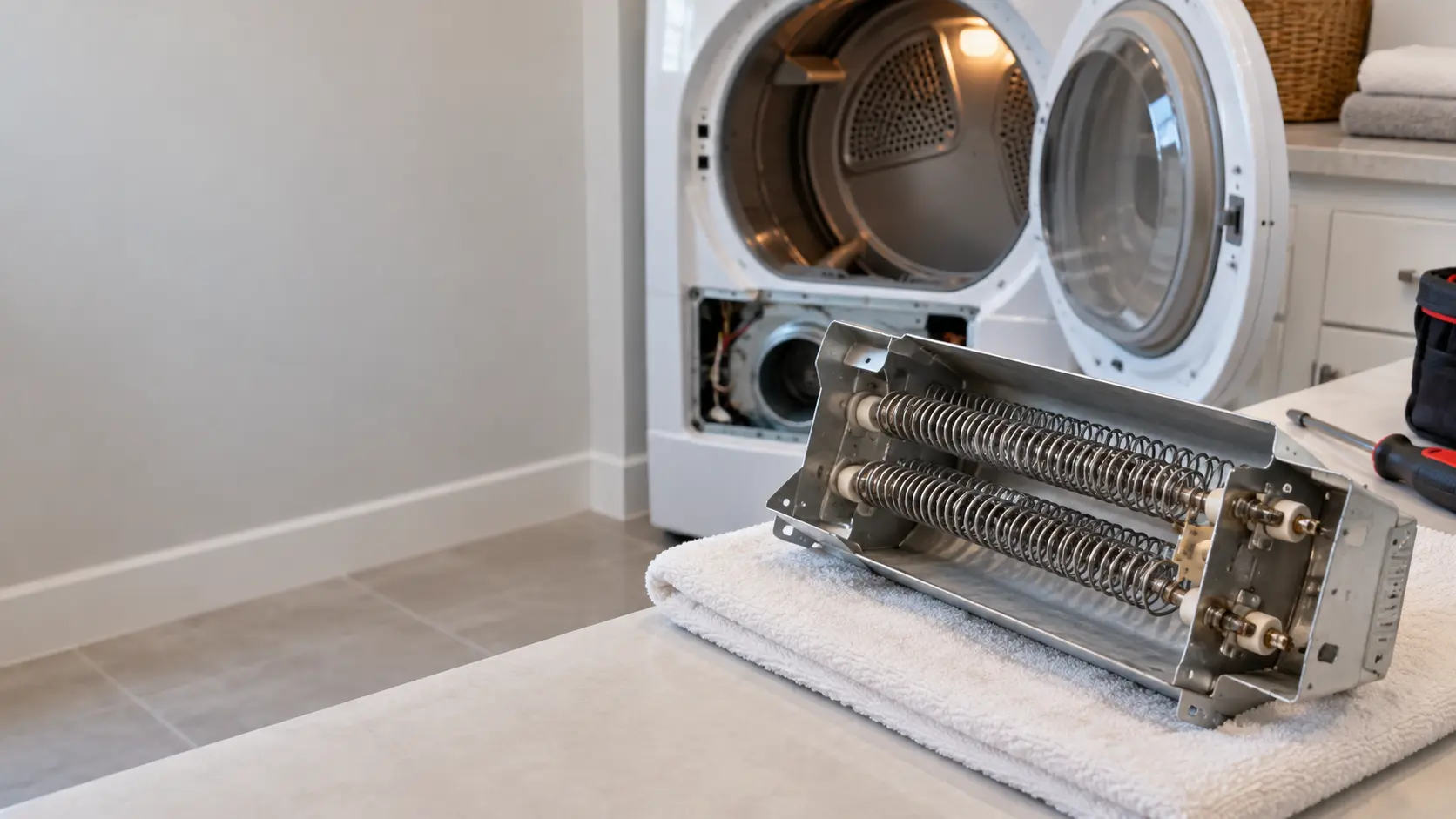
An electric dryer heats with a coil of resistance wire strung inside a metal housing, usually behind the drum or low on the rear panel. Current reaches that coil only after passing a cycling thermostat, a high-limit thermostat and, on most models, a thermal fuse, all mounted on the heater housing or the blower outlet.
The gas heat path
A gas dryer burns natural gas or propane in a burner tube low in the cabinet. A glowing igniter lights it, a flame sensor proves the flame is there, and a pair of solenoids on the valve let the gas through. The same thermostats and fuse guard the burner circuit, exactly as they guard an element.
Heat-pump and condenser models
A heat-pump dryer reuses its air in a closed loop and strips the moisture out through a condenser, so it never runs as hot as a vented machine. ENERGY STAR notes that certified dryers generally use lower temperatures than standard ones. A drum that feels warm rather than hot is expected on these models, and the honest test is whether the clothes finish dry.
Source: ENERGY STAR — Clothes dryers — Certified dryers generally use lower temperatures; heat pump dryers reuse air in a closed loop
Electric dryers: check both halves of the circuit
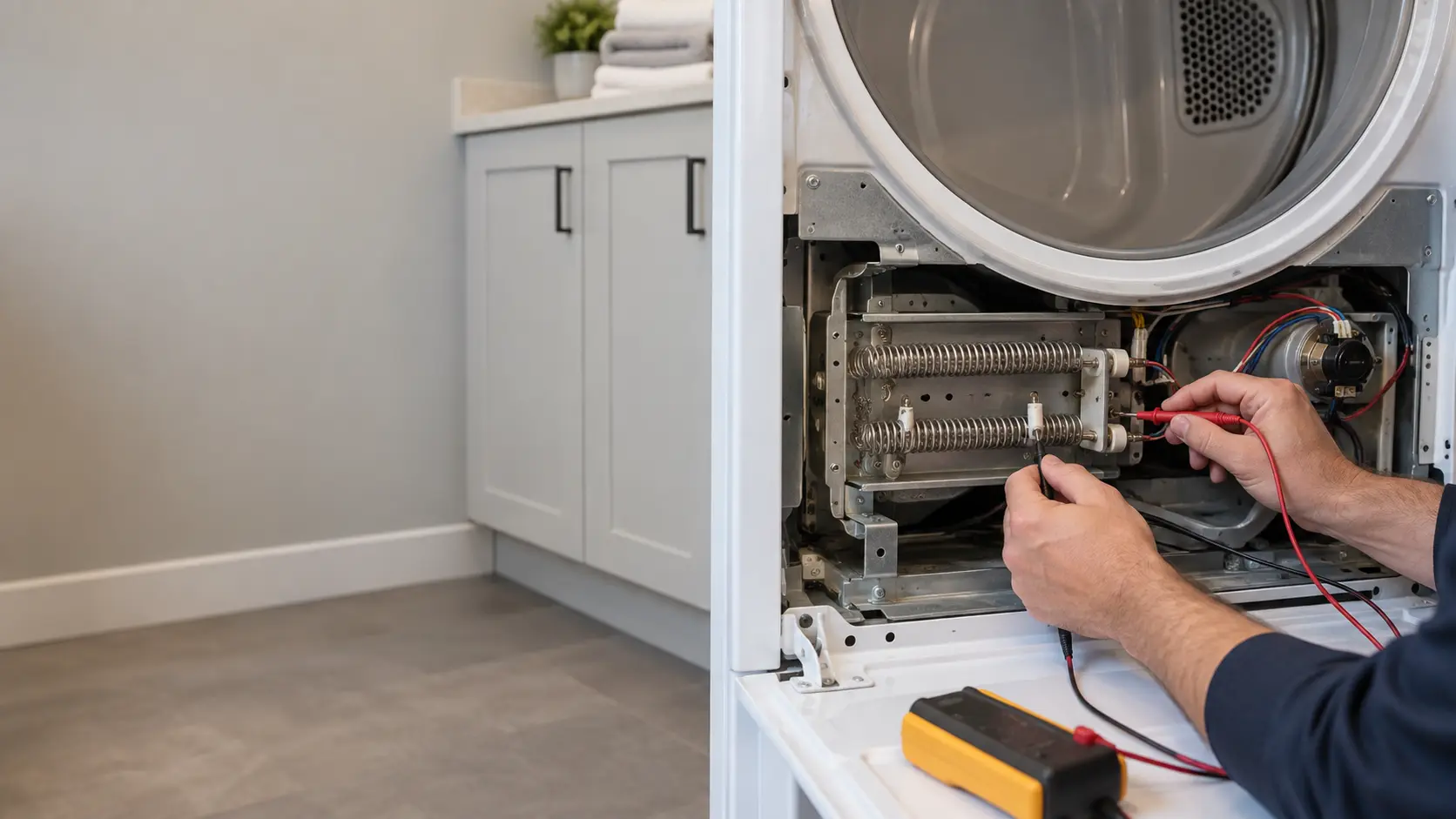
A standard US electric dryer runs on 240 volts from its own 30-amp circuit. Whirlpool describes that circuit as fused on both sides of the line, with one side running the motor and the other feeding the heating element. The motor needs only 120 volts, so it keeps the drum turning when one side has tripped, and the element sits cold.
At the panel, the dryer breaker is a double-width handle joined by a tie bar. One side can trip internally while the handle barely moves, so a glance proves little. Push it firmly all the way off, then back on. Older homes with a fuse box usually hold the dryer circuit in a pull-out block with two cartridge fuses, and one of them can blow on its own.
- A dryer that has never heated since it was installed may be on a 120-volt supply or a wrongly wired cord.
- Whirlpool asks for the terminal screws at the dryer to be tight; a loose or scorched terminal block drops one leg just like a tripped breaker.
- A breaker that trips again right after a reset is a warning; leave the circuit off until someone has looked at it.
Source: Whirlpool — Dryer is not heating — 30-amp circuit on two breakers at 240 volts; tight terminal screws; a gas drum turns with the valve closed; Air Only adds no heat; five-minute test
Gas dryers: supply, igniter and valve
Whirlpool points out that the drum of a gas dryer still turns when the shutoff valve is closed, which makes the first check free. The valve sits on the supply pipe behind the dryer, and it is open when the handle lies parallel to the pipe. Valves get nudged closed when a dryer is pulled out for cleaning or pushed back after a move. On propane, an empty tank or a closed tank valve gives the same cold drum.
Many gas dryers have a small viewing port low on the front or behind a lower access panel. Start a heated cycle and watch it: the igniter should glow orange, a blue flame should appear, and the glow should fade once the burner is lit. What you see there narrows the cause to one or two parts.
The igniter never glows
No glow at all points to the igniter itself, a brittle ceramic part that cracks with age, or to something upstream of it that has opened, such as the thermal fuse or the flame sensor.
It glows, then goes dark with no flame
An igniter that glows, switches off and never lights the gas usually means the valve coils are not opening. Coils often give up only once they are warm, which is why a dryer can heat on the first load of the day and not on the second.
Source: Whirlpool — Dryer is not heating — 30-amp circuit on two breakers at 240 volts; tight terminal screws; a gas drum turns with the valve closed; Air Only adds no heat; five-minute test
Parts that shut off the heat on purpose
Two of the switches in front of the heat source exist to protect the house, and they usually open because air stopped moving. CPSC warns that lint can block the airflow and cause excessive heat build-up. When exhaust cannot leave, the temperature around the heater climbs, the high-limit thermostat starts cutting out, and eventually the thermal fuse opens for good.
The timeline tells you a lot. Heat that faded over weeks, with loads taking longer and longer until the dryer went cold, almost always has a vent problem behind it. A dryer that heated normally one day and not the next, with a clear vent, points more toward a broken element coil or a worn igniter.
- Thermal fuse: a one-time link that does not reset and has to be replaced
- High-limit thermostat: opens at a set temperature and closes again once it cools
- Cycling thermostat: holds the drum air in range by pulsing the heat through each load
- Element or igniter: the heat source itself, which simply wears out with use
Source: CPSC — Overheated clothes dryers can cause fires (Pub. 5022) — Lint blocks airflow and causes excessive heat build-up
Settings that look like a heating failure
Whirlpool notes that Air Only and Air Fluff cycles add no heat at any point, and a dial knocked onto one of them looks exactly like a burned-out heater. Delicate and low settings run cooler on purpose, and some eco options trade temperature for time. The quickest honest test is the one Whirlpool itself suggests: an empty drum, a heated timed cycle, five minutes, then a hand inside.
On a stacked pair or laundry center the dryer controls often sit above eye level, and a knob turned by an elbow while loading the washer below is an easy thing to miss.
Source: Whirlpool — Dryer is not heating — 30-amp circuit on two breakers at 240 volts; tight terminal screws; a gas drum turns with the valve closed; Air Only adds no heat; five-minute test


