


Dryer
Overheating
The cabinet, the door or the clothes come out far hotter than normal, sometimes before the dryer shuts itself off.
Mon–Sat, 8am–8pm
- Fire or gas risk
- 5 questions that narrow it
- 5 causes, cheapest first
Book a visit
Three short steps, about a minute.
or call (844) 314-5837
Loading appointment form…
The appointment form couldn’t load. Please try again.
Switch it off before anything else
Overheating is a fire risk. Stop the dryer, unplug it or turn off its breaker, and do not run another load until the cause is found. Clear lint only once everything is cool. If there is smoke or a flame, leave the house and call emergency services from outside.
What it
usually means.
A dryer is built to run hot air through the drum and straight out the vent. When it overheats, the air is either not leaving fast enough or the heat is not being switched off when it should be. A restricted vent is the usual reason: the cycling thermostat keeps turning the heat on and off, the high-limit thermostat trips, and in the worst case the thermal fuse blows. A cycling thermostat stuck closed does the same thing with a clear vent. Either way, heat builds where lint collects, which is why overheating counts as a fire risk rather than a nuisance.
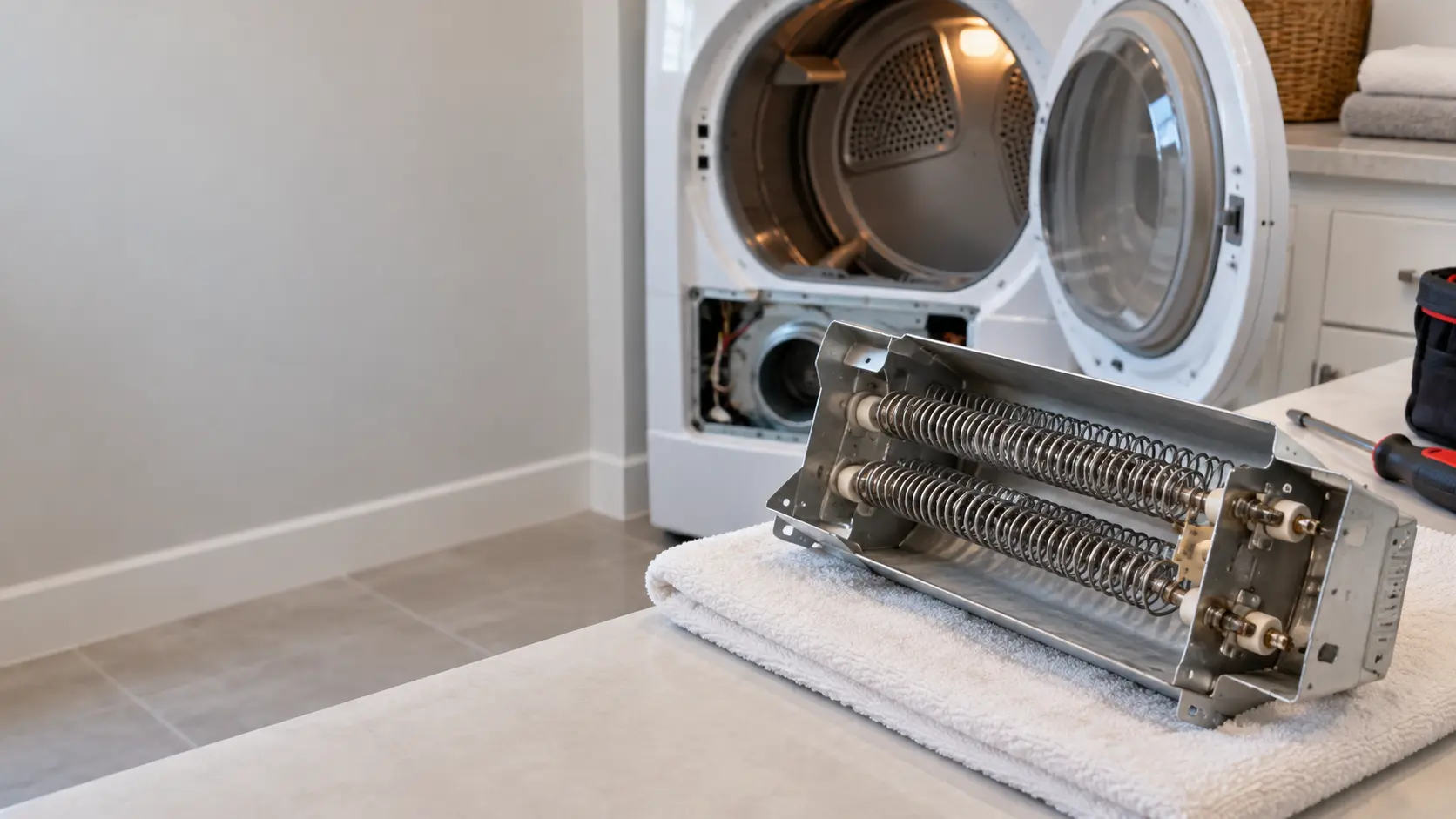 The 5 causes, cheapest first
Answer these first
Is the top of the cabinet too hot to keep a hand on?
Do clothes come out hot enough to feel scorched, or smell singed?
Does the dryer shut off by itself partway through, then restart after it cools?
Is the airflow at the outside vent hood weak, or does the flap barely move?
Is the laundry room itself noticeably warmer or more humid than usual during a load?
Check these
before you book.
Dryer overheating: 5 checks, and none of them costs anything.
Stop the dryer, unplug it or switch off its breaker, and let it cool fully before checking anything.
With the dryer cool, clean the lint screen and wash it with warm soapy water if it holds water instead of letting it pass.
Pull the dryer out and look for a crushed, kinked or foil duct; the run should be smooth rigid or semi-rigid metal.
Also worth checking
- Go outside and make sure the vent hood flap opens and is not blocked by lint, a nest or a screen.
- Run one small load on low heat later and feel the outside airflow; weak flow means the vent is still the problem.
The causes,
cheapest first.
5 things dryer overheating turns out to be, from restricted vent or crushed duct to gas valve staying open.
The cost guide-
01 low
Restricted vent or crushed duct
A long run, a crushed transition duct behind the dryer or a clogged hood outside keeps the hot air inside the dryer. Nearly every overheating dryer is checked here first.
-
02 low
Cycling thermostat stuck closed
This thermostat switches the heat off once the exhaust reaches its set point. Stuck closed, it leaves the heater on and hands the job to the safety devices.
-
03 low to moderate
Heating element shorted to the cabinet
A broken coil touching its housing can keep heating even when the controls say off. It usually shows up as heat on an air-only setting.
-
04 low to moderate
Blower wheel clogged or loose
The blower pulls air through the drum. A wheel packed with lint or slipping on its shaft moves less air, and the heat stays in the cabinet.
-
05 moderate
Gas valve staying open
On a gas dryer, a valve that does not close when the thermostat opens keeps the burner lit. It is rare and needs a technician.
-
What it costs
Every repair on the site's cost scale, side by side
Open the cost guide
What else
it could be.
Most often confused with dryer burning smell, then dryer vent clogged.
All problems


The makes
it happens on.
14 makes on this site; dryer overheating can show up on any of them. Each mark opens that make's own page.
All 14 brandsDryer Overheating,
where we come out.
9 metros, each with its own page.
All service areasTampa BayFL · 31 areas
Miami / South FloridaFL · 47 areas
New York MetroNY · 75 areas
HoustonTX · 36 areas
ChicagoIL · 50 areas
Los AngelesCA · 95 areas
San DiegoCA · 31 areas

Questions about
dryer overheating.
The dryer stopped heating after it overheated. Why?
How long should a dryer vent be?
Is foil duct really a problem?
Can I bypass the thermal fuse to keep using the dryer?
Back to your everyday
Still seeing dryer overheating?
Book with what you checked above — 5 answers save the technician the first part of the visit.