
First decide whether the stop was normal
Whirlpool describes automatic cycles such as Normal, Heavy Duty and Colors as sensing the humidity in the drum and turning off once the chosen dryness is reached, while its quick-dry cycles are timed and meant for small loads. A full load on a quick cycle, or a sensor cycle set to a lighter dryness level, finishes with damp clothes and no failure at all.
Older dryers with a mechanical dial add another trap. In the automatic section the timer moves only in bursts, and GE notes that it advances sporadically, so it can look stuck and then jump to the end. A dial that sits still for a while and then races ahead is working as designed.
Small and single-item loads
A sensor needs wet clothes brushing across its bars to read anything. GE says a sensor cycle with no load present shuts off after about two minutes. One damp shirt or a pair of sneakers barely touches the bars, so the dryer ends early for the same reason; a timed cycle suits these loads better.
A tilted cabinet and coated sensor bars
The moisture bars are usually two short metal strips just inside the drum opening, low on the front bulkhead. GE points out that a dryer tilted toward the rear lets the load slide back, away from those bars, and the fix is leveling it front to back. Bars filmed over with softener read a wet load as dry, and wiping them clean is routine upkeep; the manual says what to use.
Source: Whirlpool — Dryer stops mid-cycle — Automatic cycles sense drum humidity and turn off at the chosen dryness; quick cycles are timed for small loads; GE Appliances — Dryer timer stops during the cycle — No load: shuts off after about 2 minutes; a rear tilt moves clothes away from the sensor rods; the automatic timer advances sporadically
Stops caused by heat
The drive motor carries its own thermal protector. When the motor overheats, from a drum dragging on worn rollers, a load heavier than it was built for or a blower choked with lint, the protector opens and the motor stops. Once it cools, the protector closes and the dryer starts as if nothing had happened, until the next long load.
When a dryer shuts off mid-cycle, runs again after sitting, and quits at a similar point on the next long load, it follows this pattern. So does a cabinet top that feels hot or a laundry room noticeably warmer than usual. The screen, duct and hood come first, because a starved blower makes every part run hotter.
- It stops at roughly the same point in every long load
- It will not restart right away, then runs after sitting for a while
- The cabinet, the clothes or the air in the room feel hotter than they should
When a smell came before the stop
If the stop came with a burning or hot-electrical smell, treat it as a fire warning rather than an inconvenience: switch the dryer off at the breaker or unplug it, and leave it off. CPSC warns that lint buildup can cause excessive heat and fires in some dryers, and a dryer shutting itself down while smelling hot is exactly that case.
Source: CPSC — Overheated clothes dryers can cause fires (Pub. 5022) — Lint buildup blocks airflow, causes excessive heat and can cause fires

Door, power and control stops
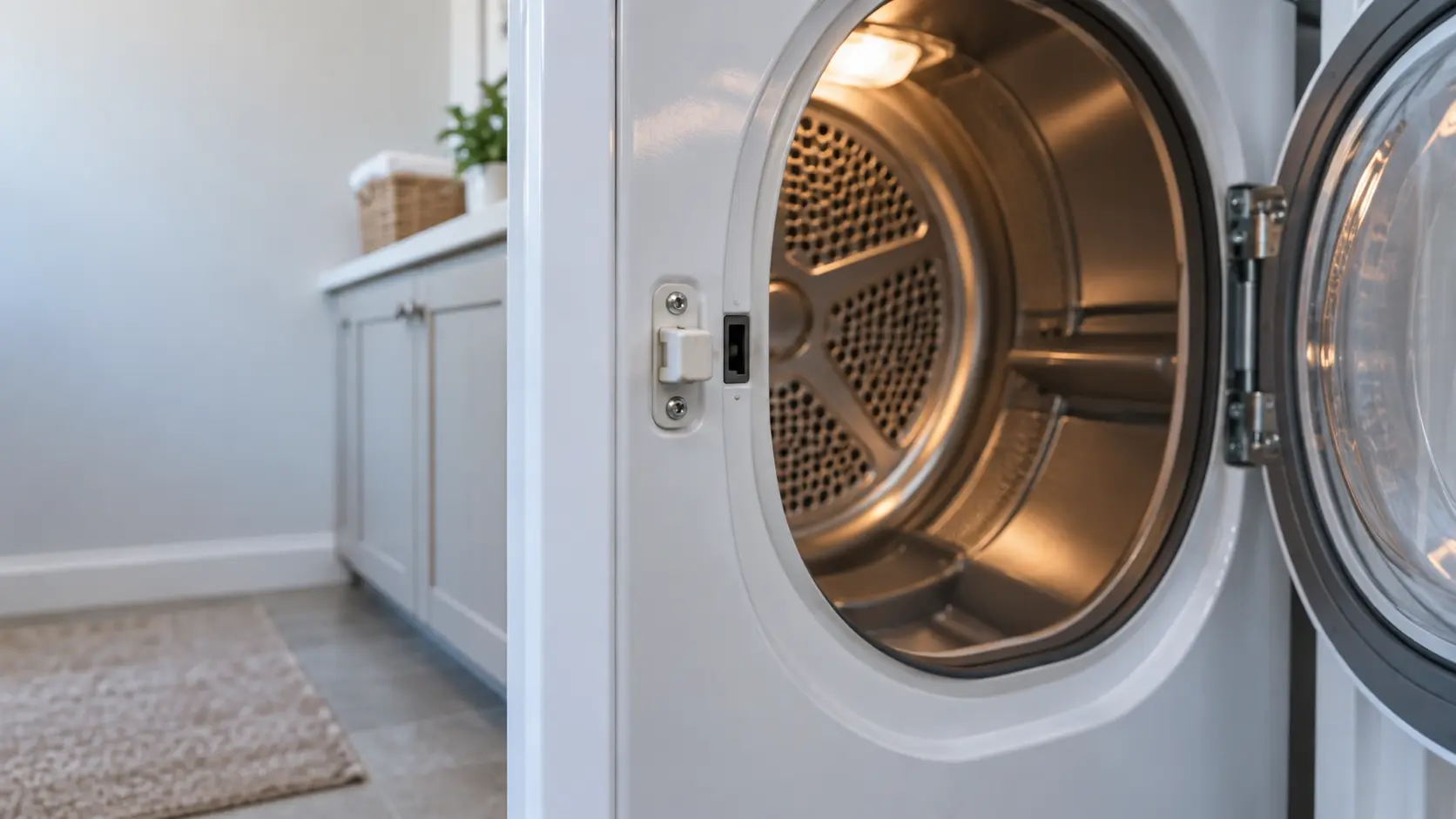
The door switch sits in the motor circuit on nearly every dryer, so a latch that barely holds stops the drum the instant it lets go. A worn catch can release as the cabinet vibrates, and on a stacked pair a laundry basket leaned against the dryer door does the same thing. If the door opens with a light touch after a stop, start there.
A loose connection at the outlet or the cord terminal block can drop power for a moment, and on an electronic control that usually ends the cycle rather than pausing it. A display that returns to its start screen partway through a load points toward power, and a plug that feels warm or a cord scorched near the terminal block means stop using the dryer.
What the display shows
Electronic dryers usually show or store a code when they stop for any reason other than a finished cycle. Copy it exactly and look it up on our error code pages for your brand; a code is only meaningful against its own maker's chart.
Reading the pattern before you call
Run one ordinary load on a timed cycle and stay nearby. The answers to these questions separate the three kinds of stop faster than most tests at a visit:
- How many minutes in did it stop?
- Were the drum and the cabinet top hot?
- Did it start again at once, or only after sitting?
- Was there a code on the panel, or did it go back to its opening screen?
- Was the door still latched, or did it open with a light touch?