

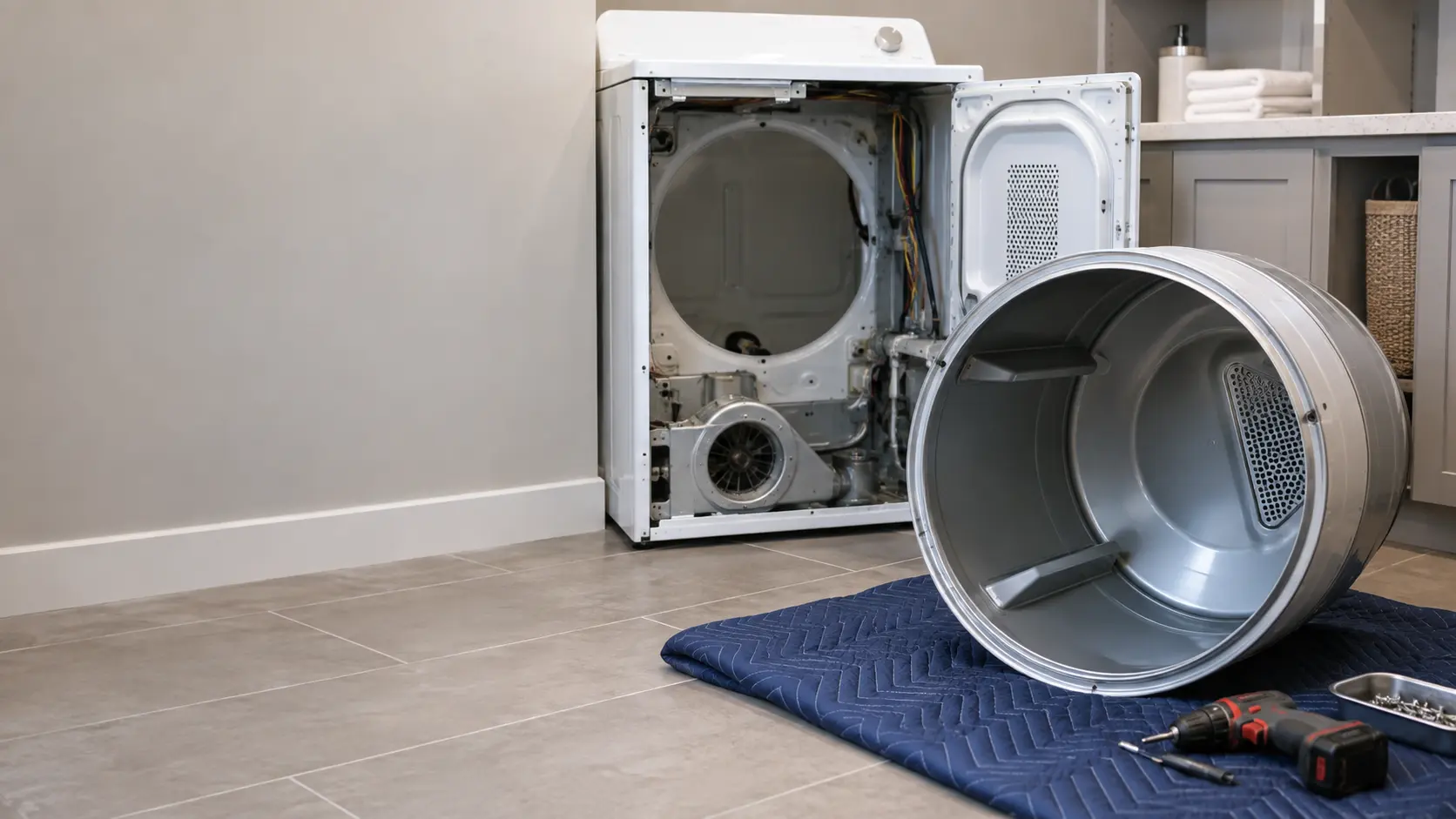
How the drum is carried and turned
A dryer drum is a large, light steel cylinder that has to turn smoothly while carrying a wet load. At the back, it usually sits on two rubber-tired rollers on short axles fixed to the rear bulkhead, or on a single center bearing on some older designs. At the front, it rests on plastic or felt glides in the front panel, or on a second pair of rollers.
The dryer belt and rollers are the parts of this assembly that wear, and both are sold as ordinary replacement parts for nearly every model in US homes. The motor, the drum and the bulkhead itself normally outlast them several times over.
The belt wraps around the outside of the drum, dips down around a spring-loaded idler pulley, and loops over the motor shaft. The idler keeps the belt tight enough to grip. Many dryers also have a switch on the idler arm that stops the motor if the belt breaks.
Why these parts wear
Rollers turn thousands of times per load, under the drum's weight plus whatever is inside. Their rubber hardens with heat, their axle bushings dry out, and the tread flattens where the drum stood still with a heavy load. Glides wear down from the drum's rotation until metal starts to touch plastic.
Reading the sounds
Stand next to the dryer with a normal load inside and listen for the pattern. Each part has a sound of its own, and the pattern narrows the list before a panel comes off.
Listen twice: once in the first minute, while the drum is cold and the rubber is stiff, and again near the end of the cycle. A roller noise that fades as the dryer warms is still a worn roller; it simply softens with heat.
- A steady thump once per drum turn: a roller with a flat spot, or a loose drum baffle.
- A high squeal that starts at the beginning of the cycle: a dry idler pulley or a roller running on a worn axle.
- A scraping or grinding at the front: glides worn through, with the drum rubbing its front panel.
- A slapping or flapping: a belt that is frayed or cracking, about to let go.
- The motor hums but the drum does not turn, or the dryer will not start at all: often a broken belt tripping the idler switch.
Not every noise is wear
Before blaming rollers, check the drum for a coin, a bra wire or a zipper pull caught in a gap. A rattle that comes and goes with the load is usually an object; a noise that is there with an empty drum is usually a part. A loud whirring from the back that stays the same with an empty drum points toward the blower wheel or motor, not the drive.

What speeds the wear
A dryer used within its design limits can go many years on its original drive. These habits and conditions shorten that:
- Loads packed so tight they cannot tumble. ENERGY STAR notes a drum needs space left for air to circulate, and the rollers carry every extra pound.
- Single heavy items, such as a king comforter, a rug or sneakers, that thump and shift weight to one side.
- A dryer that is not level, which loads one roller more than the other.
- A clogged duct that doubles the running hours, and with them the wear, without drying any more laundry.
Level it
Set a level across the top, front to back and side to side, and turn the adjustable feet until the bubble centers. On a stacked pair, level the washer underneath first; the dryer sits on its kit and follows.
Watch the running hours
Drive parts wear by the hour, not by the load. If regular loads now take two cycles, the extra time is spent on the rollers and belt as well as the heater. Clearing a blocked duct extends the life of the drive as surely as it cuts drying time.
Source: ENERGY STAR — Clothes dryers — The drum needs room for a full load to tumble freely, with space for hot air to circulate; an overlarge load takes longer to dry
What the repair involves
On most dryers, the drum has to come out to reach the rear rollers and the belt. That means opening the top or front, releasing the idler to free the belt, and lifting the drum clear. With the drum out, a sensible repair replaces all the rollers together, the idler and the belt, and checks the glides and the felt seals at each end of the drum.
This work sits in the low band of dryer repair on nearly every model, which is why a noisy drive is rarely a reason to replace a dryer. The exception is a rear bulkhead or front panel cracked around a roller axle or bearing mount, which the repair-or-replace guide covers.
Stacked dryers and laundry centers follow the same principle, though access differs. Some open from the front with the stack in place; others need the dryer lifted down first, which adds time but not a different kind of repair. On a gas dryer, the work is done with the gas valve closed and the connector left attached unless the machine must move.


