


Why length and turns matter
A dryer pushes a steady stream of hot, damp air through the duct, and every foot of pipe and every elbow resists it. The blower does not get stronger to compensate; the air simply moves slower, carries less moisture out per minute, and drops more lint along the way.
GE's installation instructions list what an overlong run costs: longer drying, higher energy use, a shorter dryer life, and lint that accumulates into a fire hazard. That is why the allowed dryer vent length is a table rather than a single number.
The cheapest fix is made before the dryer ever arrives. Speed Queen's instructions ask for the dryer to be placed so the exhaust duct is as short as possible, and for any old duct to be cleaned before a new machine is connected to it; a new dryer on a packed old run starts life already restricted.
Source: GE Appliances — Dryer Owner's Manual and Installation Instructions (49-3000386) — Exhaust length table by elbows and hood type, elbow counting rules, 8 ft transition limit, joint, slope, hood and booster-fan rules; Alliance Laundry Systems (Speed Queen) — Installation Instructions for Dryers, D516902 — Maximum 4-inch rigid duct length by elbows, 6 ft deducted per extra elbow, flexible metal limited to 7.87 ft
Reading the manufacturer's table
Every installation manual carries a chart of maximum run length by number of 90-degree elbows, usually with a second column for outside hoods that restrict air more. The numbers differ widely between makers, which is the main reason to use the one for the dryer you actually own.
| 90° elbows | GE (standard-vent models) | Speed Queen |
|---|---|---|
| 0 | 90 ft | 65 ft |
| 1 | 60 ft | 55 ft |
| 2 | 45 ft | 47 ft |
| 3 | 35 ft | 36 ft |
| 4 | 25 ft | 28 ft |
Counting elbows correctly
GE's rules are a good model. Any bend sharper than 45 degrees counts as a full 90; two 45-degree elbows count as one; the turn inside the dryer for a side or bottom exhaust counts too; and the connector behind the machine is part of the total length, not an extra.
The outside hood changes the answer
A hood with a small or louvered opening is listed for short runs only. In GE's table, swapping to that style cuts the zero-elbow limit from 90 feet to 60, so a new hood on an old run can make a compliant vent too long.
Where local code is stricter
Both manuals tell the installer to follow local codes as well, and some jurisdictions set their own maximum for dryer exhaust. Where the two disagree, the shorter limit is the one that applies. If a laundry room is being moved or built, the building department can say which number the inspector will use before any pipe goes in.
Source: GE Appliances — Dryer Owner's Manual and Installation Instructions (49-3000386) — Exhaust length table by elbows and hood type, elbow counting rules, 8 ft transition limit, joint, slope, hood and booster-fan rules; Alliance Laundry Systems (Speed Queen) — Installation Instructions for Dryers, D516902 — Maximum 4-inch rigid duct length by elbows, 6 ft deducted per extra elbow, flexible metal limited to 7.87 ft
The right material
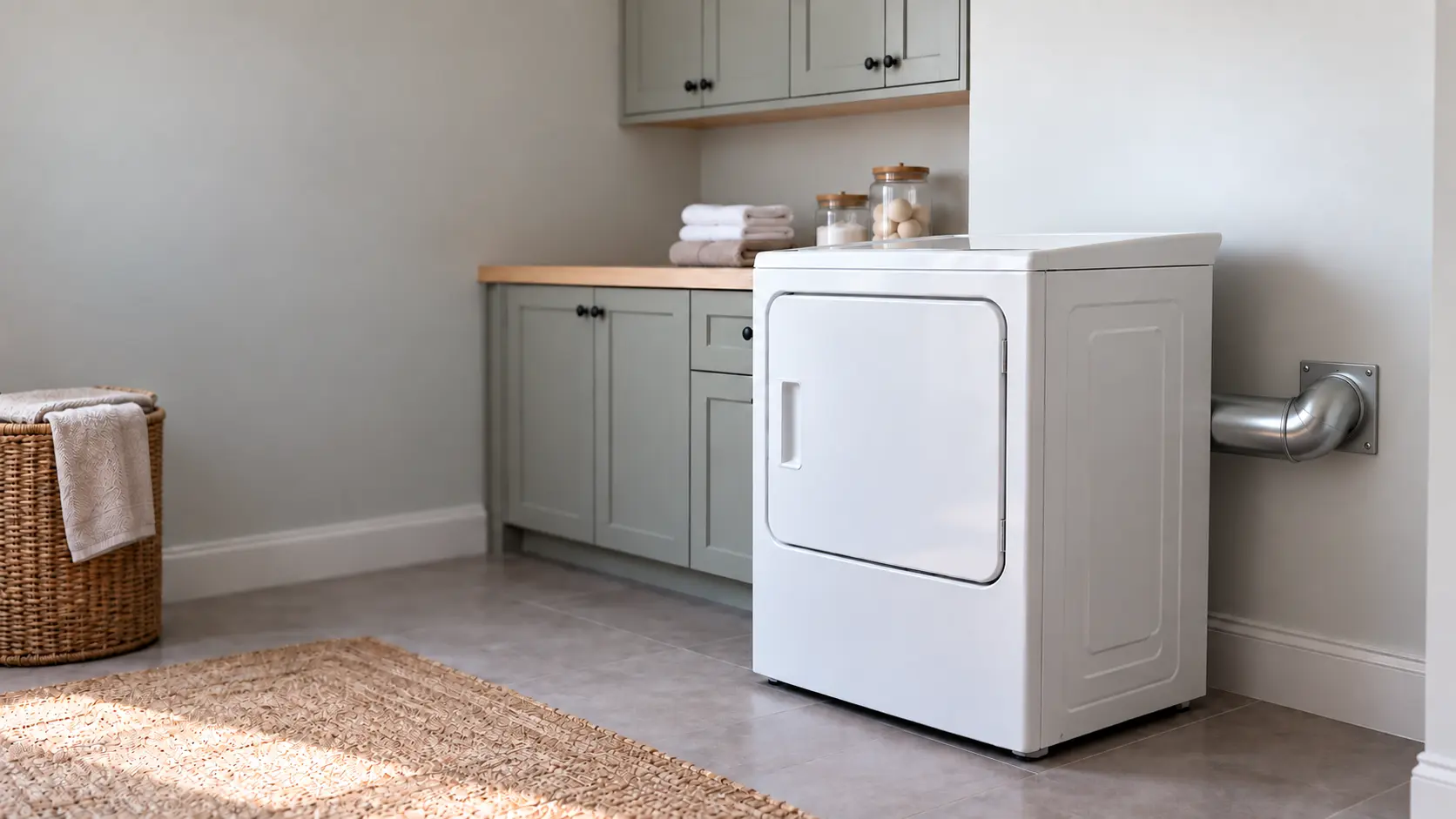
The fixed part of the run, through walls, floors and ceilings, should be smooth-walled rigid metal. Its interior does not trap lint the way ribbed pipe does, and it cannot sag or be crushed. CPSC recommends replacing plastic or foil accordion ducting with rigid or corrugated semi-rigid metal for that reason.
- Rigid metal: the house duct, and the best choice for the connector too.
- Semi-rigid or flexible metal: only as the connector between dryer and wall, UL-listed, kept as short and straight as possible.
- Thin foil accordion duct: only where the manufacturer allows it as a last resort, and never hidden.
- Plastic or vinyl: not acceptable anywhere in the exhaust path.
The connector behind the dryer
This short piece takes the most abuse, because the dryer is pushed against it. GE recommends elbows at both the dryer outlet and the wall so the machine can sit close without folding the duct, stretching a flexible connector to its full length before cutting off the excess, and keeping it as straight as possible. It must never be run inside a wall, ceiling or floor.
Leaving a way in for cleaning
A run that cannot be reached cannot be cleaned. GE asks installers to provide access for inspection and cleaning, especially at turns and joints, and calls for the exhaust system to be inspected and cleaned at least once a year.
Source: GE Appliances — Dryer Owner's Manual and Installation Instructions (49-3000386) — Exhaust length table by elbows and hood type, elbow counting rules, 8 ft transition limit, joint, slope, hood and booster-fan rules; CPSC — Overheated Clothes Dryers Can Cause Fires (Publication 5022) — Replace plastic or foil accordion ducting with rigid or semi-rigid metal duct
Details that trap lint
A run of the right length can still clog early if it was assembled carelessly. These come from the installation sections of GE's and Speed Queen's manuals, and each one is visible on an exposed run in a basement or garage.
- Sections joined with the male end pointing away from the dryer, so air flows over each seam, not into it.
- Joints sealed with aluminum foil tape or clamps, with no sheet-metal screws poking into the duct.
- Horizontal runs sloping down toward the outside, about a quarter inch per foot.
- Insulation on any stretch through an unheated attic or crawl space, to stop condensation.
- A hood with a damper flap at least 12 inches above the ground, with no screen over the opening.
- No booster fan added inside the duct.
Source: GE Appliances — Dryer Owner's Manual and Installation Instructions (49-3000386) — Exhaust length table by elbows and hood type, elbow counting rules, 8 ft transition limit, joint, slope, hood and booster-fan rules; Alliance Laundry Systems (Speed Queen) — Installation Instructions for Dryers, D516902 — Maximum 4-inch rigid duct length by elbows, 6 ft deducted per extra elbow, flexible metal limited to 7.87 ft


