

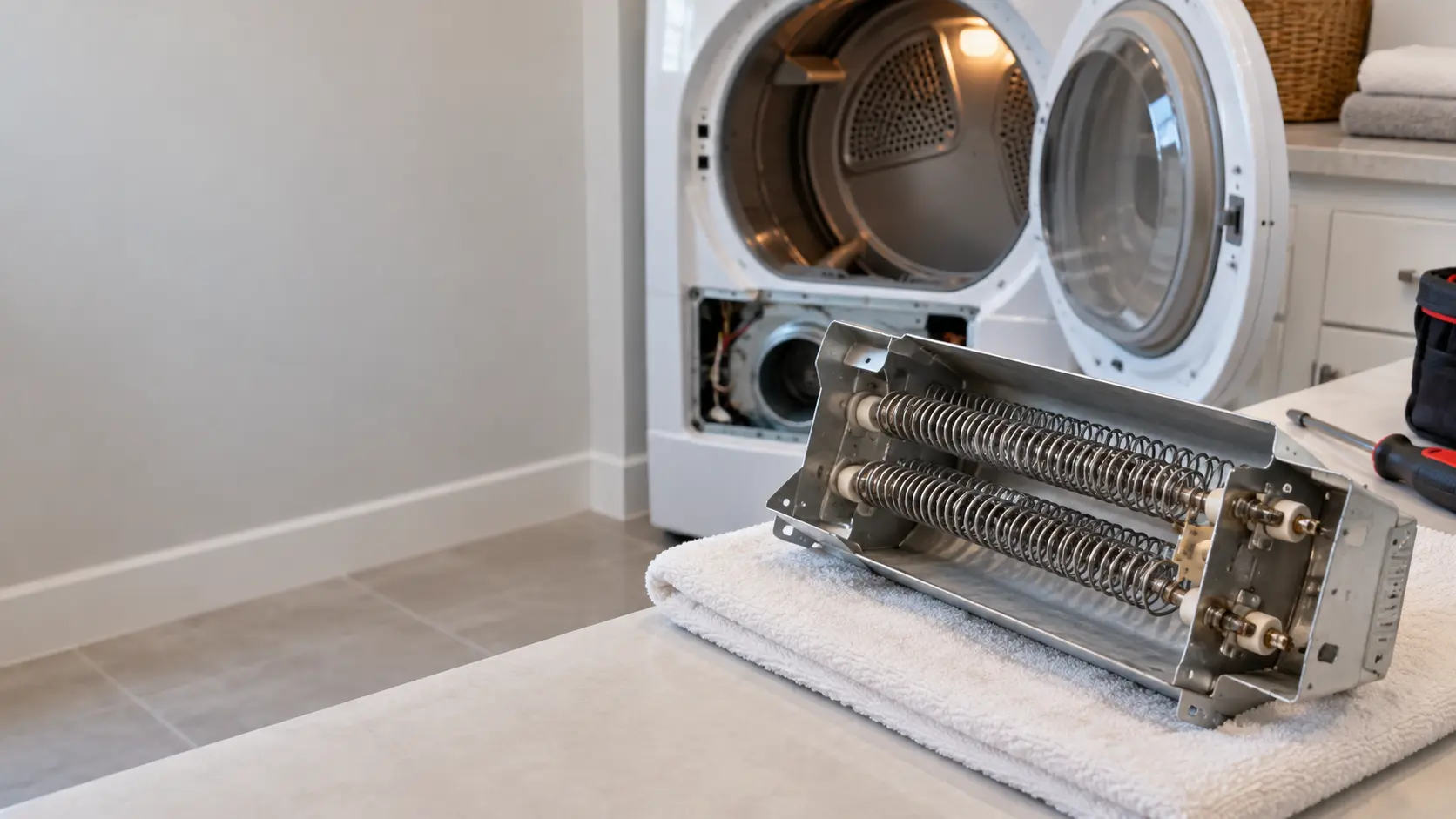
Why an electric dryer needs 240 volts
A US home is fed with two 120-volt legs. Across both, the voltage is 240, and that is what an electric dryer's heating element runs on. The motor, the drum light and the controls use 120 volts, taken from one leg and the neutral. The panel shows this as a double breaker, two handles tied together, usually marked 30.
Because the heat and the motor share the circuit on different legs, a single tripped half can leave the drum turning with no heat. GE's troubleshooting table tells owners to check both breakers or both fuses for exactly that reason.
Source: GE Appliances — Dryer Owner's Manual and Installation Instructions (49-3000386) — 30-amp individual circuit with 10-gauge copper; four-wire required in new construction since 1996 and on GFCI breakers; cord, terminal and strain-relief requirements; gas dryer on a grounded 15- or 20-amp outlet; check both breakers
Three slots or four
Count the openings in the outlet behind the dryer. Three large slots mean a three-wire circuit: two hot legs and a neutral that also serves as the ground path. Four openings, one of them round or U-shaped, mean a four-wire circuit with a separate grounding conductor.
| Three-wire | Four-wire | |
|---|---|---|
| Conductors | Two hots and a neutral | Two hots, a neutral and a ground |
| Where you find it | Many homes wired before 1996 | New construction, and required in mobile homes |
| At the dryer | Neutral bonded to the cabinet with a strap | Strap removed; ground wire to its own screw |
| On a GFCI breaker | Not permitted | Required |
What changed in 1996
GE's instructions note that since January 1, 1996, the National Electrical Code has required a four-wire connection for electric dryers in new construction, and that three-wire is not for new work. An older three-wire outlet that was installed correctly is not automatically unsafe, but it is the reason a new dryer's cord is sold separately.
The strap on the terminal block
Inside the small cover on the back of the dryer, a metal strap or a green wire joins the neutral terminal to the cabinet. On a three-wire hookup it stays; on a four-wire hookup it comes off and the cord's green wire takes its place. A four-wire cord installed with the strap still in place defeats the separate ground.
When the breaker is a GFCI
GE states that if the dryer circuit is protected by a GFCI breaker, three-wire installation is not permitted and both the house wiring and the dryer must be set up for four-wire.
Source: GE Appliances — Dryer Owner's Manual and Installation Instructions (49-3000386) — 30-amp individual circuit with 10-gauge copper; four-wire required in new construction since 1996 and on GFCI breakers; cord, terminal and strain-relief requirements; gas dryer on a grounded 15- or 20-amp outlet; check both breakers; Alliance Laundry Systems (Speed Queen) — Installation Instructions for Dryers, D516902 — Three-wire and four-wire hookups on a separate 30-amp branch circuit; no extension cord or adapter

What a correct cord looks like
Most electric dryers ship without a cord so the installer can match it to the outlet. The cord and its connection are part of the dryer, and a poor one is a common source of heat at the back of the machine.
- New, UL-listed and rated 240 volts, 30 amps, with the same number of prongs as the outlet.
- Ring terminals, or spade terminals with upturned ends, under each screw, tightened firmly.
- The neutral, white or center wire, on the center terminal.
- A listed strain relief clamped where the cord enters the dryer, so a tug cannot pull on the terminals.
- The terminal block cover put back in place.
Source: GE Appliances — Dryer Owner's Manual and Installation Instructions (49-3000386) — 30-amp individual circuit with 10-gauge copper; four-wire required in new construction since 1996 and on GFCI breakers; cord, terminal and strain-relief requirements; gas dryer on a grounded 15- or 20-amp outlet; check both breakers
Signs of trouble at the outlet
A 30-amp connection that is loose heats up under load, and the heat damages the connection further. USFA advises replacing wall outlets when plugs no longer fit snugly and replacing an appliance whose cord is cracked or damaged.
- The plug feels warm after a cycle, or slides in and out too easily.
- Brown or black marks on the outlet face or around the prongs.
- A smell of hot plastic behind the dryer.
- The dryer heats weakly or not at all while the drum turns.
- The breaker trips partway through a cycle.
Source: U.S. Fire Administration — Appliance and electrical fire safety — Plug major appliances directly into a wall outlet, never an extension cord; replace outlets when plugs do not fit snugly
Before a move or a new dryer
Look at the 240-volt dryer outlet in the new laundry room before the dryer is delivered, not after. Counting its slots tells you which cord to buy, and a quick look at its face and cover plate tells you whether it has been overheating. An outlet mounted low and directly behind the machine is worth noting too, since a plug pressed flat against the wall bends the cord at the prongs.
Speed Queen's instructions ask for the receptacle to sit on the wall next to the dryer, where it can be reached with the machine in place so the power can be disconnected. They also size the house wiring by distance: 10-gauge copper for a run under 15 feet from the panel, 8-gauge for a longer one.
Dryers wired without a plug
Some dryers, particularly in older homes and some manufactured homes, are connected directly to the circuit with no outlet at all. GE covers this as a direct-wire connection with 10-gauge copper and a listed strain relief. Disconnecting one for a move means switching off the breaker and opening the terminal block, which is a job for an installer or electrician.
Source: GE Appliances — Dryer Owner's Manual and Installation Instructions (49-3000386) — 30-amp individual circuit with 10-gauge copper; four-wire required in new construction since 1996 and on GFCI breakers; cord, terminal and strain-relief requirements; gas dryer on a grounded 15- or 20-amp outlet; check both breakers; Alliance Laundry Systems (Speed Queen) — Installation Instructions for Dryers, D516902 — Three-wire and four-wire hookups on a separate 30-amp branch circuit; no extension cord or adapter
Gas dryers and the 120-volt outlet
A gas dryer makes its heat with a burner, so it needs only an ordinary grounded three-prong outlet. GE specifies an individual, properly polarized and grounded 15- or 20-amp circuit. The ground prong must never be cut off and an adapter must never be used.
If a gas dryer moves into a laundry room that has only a 240-volt outlet, the answer is a new 120-volt outlet installed by an electrician, not a converter.
Source: GE Appliances — Dryer Owner's Manual and Installation Instructions (49-3000386) — 30-amp individual circuit with 10-gauge copper; four-wire required in new construction since 1996 and on GFCI breakers; cord, terminal and strain-relief requirements; gas dryer on a grounded 15- or 20-amp outlet; check both breakers


