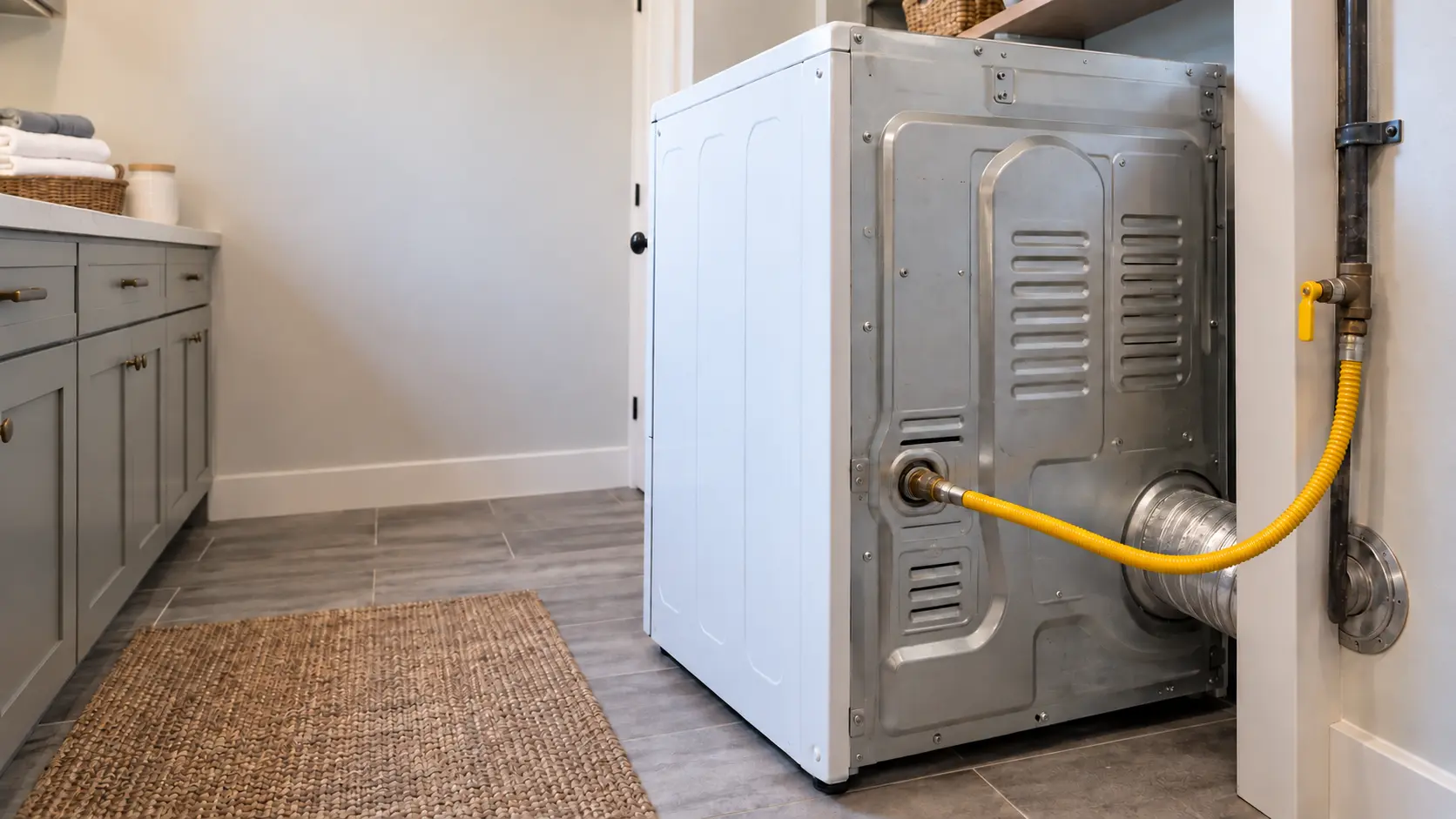
The parts, from the wall to the dryer
GE's and Speed Queen's installation instructions describe the same sequence. Read from the house pipe toward the dryer, a correct gas dryer connection looks like this:
- A rigid supply pipe coming out of the wall or floor. GE calls for at least 1/2-inch pipe; Speed Queen allows 3/8-inch on runs shorter than 20 feet.
- A manual shutoff valve on that pipe, within 6 feet of the dryer, in the same room, reachable with the dryer in place.
- A small plugged fitting, 1/8-inch NPT, just upstream of the dryer connection, where an installer can attach a pressure gauge.
- A flexible connector, new with this dryer, joined to the valve with a flare adapter.
- An adapter or elbow at the dryer's own 3/8-inch threaded inlet at the lower back of the cabinet.
Reading the valve
Most dryer shutoffs are quarter-turn valves. With the handle lined up along the pipe, gas flows; turned crosswise, it is closed. In Massachusetts, GE's instructions note that a ball valve must be the T-handle type and the connector may not exceed 4 feet.
What is on the threads
Threaded joints are sealed with pipe compound rated for natural and propane gas, or with PTFE tape, applied to the male threads. GE also tells installers to hold the dryer's inlet pipe with a wrench while tightening, so the stub does not twist inside the cabinet, and to tighten with two wrenches without overtightening. A cracked or bent inlet is not something the owner can see, which is one more reason to leave this joint alone.
Source: GE Appliances — Dryer Owner's Manual and Installation Instructions (49-3000386) — Shutoff within 6 ft, 1/2-inch supply, 1/8-inch plugged tapping, new listed connector up to 4 ft, propane kit and pressure, altitude derating, closet and garage rules, soap-solution leak test; Alliance Laundry Systems (Speed Queen) — Installation Instructions for Dryers, D516902 — 3/8-inch NPT inlet, supply pipe size by run length, new stainless steel connector, gas type on the nameplate, disconnect during pressure tests above 1/2 psi
The flexible connector
The connector is the part most likely to be wrong, because it is the part people reuse. GE says to use a new, design-certified flexible connector with every installation and never to reuse an old one, and Speed Queen's instructions specify a new flexible stainless steel connector.
Uncoated brass: replace it
Nicor Gas, citing CPSC, warns that older uncoated brass connectors can separate where the tubing meets the end fittings, causing a serious leak or fire. Nicor notes they have not been made for more than 20 years, but many are still in service. Stainless steel, bare or plastic-coated, is what a current connector looks like.
Kinks and crushing
A connector should curve gently from the valve to the dryer, not fold sharply or lie pinned between the cabinet and the wall. Con Edison notes that connectors grow brittle and crack with age, and asks owners not to step, lean or set things on them.
Source: GE Appliances — Dryer Owner's Manual and Installation Instructions (49-3000386) — Shutoff within 6 ft, 1/2-inch supply, 1/8-inch plugged tapping, new listed connector up to 4 ft, propane kit and pressure, altitude derating, closet and garage rules, soap-solution leak test; Alliance Laundry Systems (Speed Queen) — Installation Instructions for Dryers, D516902 — 3/8-inch NPT inlet, supply pipe size by run length, new stainless steel connector, gas type on the nameplate, disconnect during pressure tests above 1/2 psi; Nicor Gas — Appliance connectors — Uncoated brass connectors can separate and should be replaced with stainless steel or coated connectors by a professional; Con Edison — Home gas safety — Connectors become brittle with age; do not step, lean or place objects on them

Natural gas or propane
Gas dryers leave the factory set for natural gas. The type a dryer is set for is printed on its rating plate, which Speed Queen places in the door recess. Running on propane requires the manufacturer's conversion kit, installed by qualified personnel, and GE adds that propane pressure must not exceed 13 inches of water column.
Altitude matters too. GE's instructions say input ratings need no adjustment up to 2,000 feet and should be reduced 4 percent for each 1,000 feet above that, which is set by the installer, not the owner.
Source: GE Appliances — Dryer Owner's Manual and Installation Instructions (49-3000386) — Shutoff within 6 ft, 1/2-inch supply, 1/8-inch plugged tapping, new listed connector up to 4 ft, propane kit and pressure, altitude derating, closet and garage rules, soap-solution leak test; Alliance Laundry Systems (Speed Queen) — Installation Instructions for Dryers, D516902 — 3/8-inch NPT inlet, supply pipe size by run length, new stainless steel connector, gas type on the nameplate, disconnect during pressure tests above 1/2 psi
The room around it
A gas dryer burns fuel indoors and sends its exhaust outside, so the space it sits in is part of a correct installation. Speed Queen's instructions add that enough make-up air must reach the room to replace what the dryer blows out, because the burner draws its combustion air from the same space.
- No other fuel-burning appliance in the same closet as a gas dryer.
- Closet doors louvered, with at least 60 square inches of opening, or 120 if a washer shares the closet (GE).
- In a garage, the dryer raised at least 18 inches above the floor.
- The exhaust duct run outdoors, never into the room, an attic or a chimney.
- Gasoline, solvents and other flammable liquids stored well away.
Source: GE Appliances — Dryer Owner's Manual and Installation Instructions (49-3000386) — Shutoff within 6 ft, 1/2-inch supply, 1/8-inch plugged tapping, new listed connector up to 4 ft, propane kit and pressure, altitude derating, closet and garage rules, soap-solution leak test
How it is tested
After connecting, the installer opens the valve and brushes a soap solution over every joint. GE specifies a solution without ammonia, which can damage brass fittings, and says never to use an open flame. Growing bubbles mean a leak: the valve is closed, the joint retightened and the test repeated.
Both manuals also note that the dryer must be disconnected from the house piping if that piping is pressure-tested above 1/2 psi, which matters if a plumber is working on the gas lines elsewhere in the house.
Source: GE Appliances — Dryer Owner's Manual and Installation Instructions (49-3000386) — Shutoff within 6 ft, 1/2-inch supply, 1/8-inch plugged tapping, new listed connector up to 4 ft, propane kit and pressure, altitude derating, closet and garage rules, soap-solution leak test; Alliance Laundry Systems (Speed Queen) — Installation Instructions for Dryers, D516902 — 3/8-inch NPT inlet, supply pipe size by run length, new stainless steel connector, gas type on the nameplate, disconnect during pressure tests above 1/2 psi
A flashlight check you can make
Standing beside the dryer and shining a light down the gap is enough to answer most of the questions above. Nothing needs to be touched or moved, and if the answer to any of these is no, the next step is a call, not a wrench.
- Can you see a shutoff valve, and would you be able to reach it with the dryer in place?
- Is the connector stainless steel, bare or coated, rather than dull gold uncoated brass?
- Does it curve gently, with no sharp fold and no part squeezed against the wall?
- Is the vent duct beside it connected and uncrushed, since both share the same narrow space?
- Is the area behind the dryer free of stored bottles, boxes and fallen laundry?